Plants
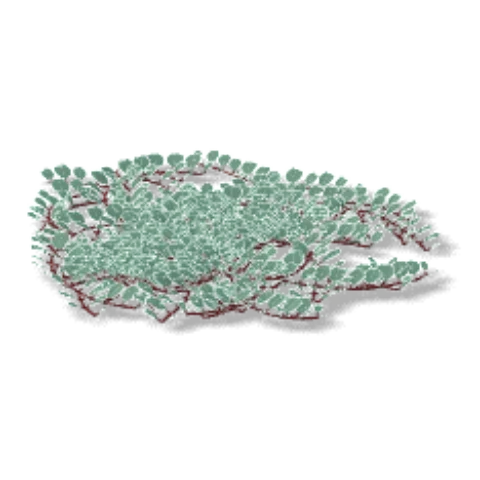
Pilea 'Aquamarine'
Pilea libanensis
BeginnerFine in a closed jar
Minute silver-blue leaves in a creeping carpet.
What the simulation uses
- Light
- 2,500 to 10,000 lux
- The brightness it grows well in.
- Humidity
- 60 to 95 % RH
- Air moisture it is happy in; below the lower end it dries out.
- Temperature
- 18 to 27 °C
- Comfortable range; outside it growth slows.
- Dies at
- below 10 or above 32 °C
- Days beyond these temperatures kill it.
- Soil pH
- 5.5 to 6.5 pH
- Soil acidity it prefers.
- Grows up
- 0.65 cm/month
- How fast it gains height in good conditions.
- Spreads
- 2.75 cm/month
- How fast its edge creeps outwards.
- Copes with wet
- fair
- How well it stands soggy soil; poor means rot comes quickly.
- Copes with still air
- good
- Sealed jars have still air; poor means grey mould finds it.
- Copes with shade
- good
- How well it holds on in dim light.
- Copes with drying
- fair
- How well it survives the jar drying out.
- Water use
- 0.09 ml/cm²/day
- Water drawn up from its roots per cm² of leaves in room air; a sealed jar cuts this to a fraction and returns it down the glass.
- Leaf drop
- 3 %/month
- Share of its leaves it sheds each month as litter for the cleanup crew.
- Soft leaves
- yes
- Soft new growth that hungry isopods will nibble.
- Full size
- 5.5 cm tall, 40 cm wide
- Its size when grown, before the lid stops it.
Care
- Day length
- 12 to 14 h
- Substrate
- Moist
What kills it
- drying out
- stem rot in waterlogged medium
Description
Sold as a groundcover for jars, it goes by names like 'Aquamarine' and 'Glauca'. Its care needs are based on related pileas. Damp soil and humid air keep it creeping happily.
Also called Pilea glauca, Pilea glauca 'Aquamarine', silver sparkle pilea.
Estimated, where sources were thin: nearly all numeric values estimated; no extension care sheet found; taxonomy of 'glauca'.