Moss
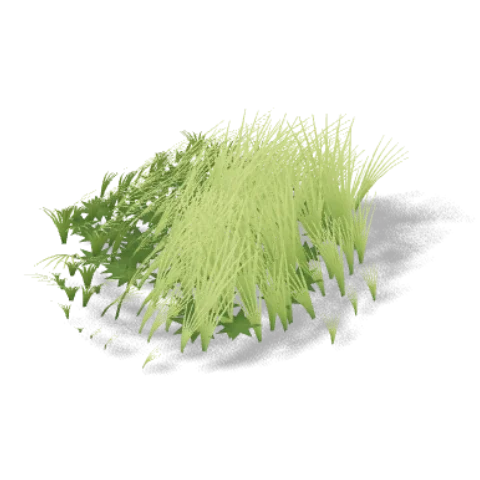
Common pocket moss
Fissidens taxifolius
EasyFine in a closed jar
Small flat fronds, like tiny feathers, on bare soil.
What the simulation uses
- Light
- 400 to 6,000 lux
- The brightness it grows well in.
- Humidity
- 75 to 100 % RH
- Air moisture it is happy in; below the lower end it dries out.
- Temperature
- 8 to 25 °C
- Comfortable range; outside it growth slows.
- Dies at
- below -20 or above 40 °C
- Days beyond these temperatures kill it.
- Soil pH
- 6 to 7.5 pH
- Soil acidity it prefers.
- Grows up
- 0.04 cm/month
- How fast it gains height in good conditions.
- Spreads
- 0.07 cm/month
- How fast its edge creeps outwards.
- Thickens
- 1.15 %/month
- How fast its cover fills in on its own ground.
- Copes with wet
- good
- How well it stands soggy soil; poor means rot comes quickly.
- Copes with still air
- good
- Sealed jars have still air; poor means grey mould finds it.
- Copes with shade
- excellent
- How well it holds on in dim light.
- Copes with drying
- fair
- How well it survives the jar drying out.
- Water use
- 0.035 ml/cm²/day
- Water that evaporates off the cushion each day in room air.
- Holds water
- 0.25 ml/cm²
- Water a cm² of moss soaks up and keeps.
- Grows on
- soil, stone
- Where it can take hold and spread. Moss that cannot grow on stone thins out there.
Care
- Day length
- 10 to 14 h
- Substrate
- Moist
What kills it
- drying
- very acid substrate
- bright light
Description
Shoots are only 5 to 22 mm long and grow on bare soil in lightly shaded woodland. It manages in quite dim light and dislikes bright sun. Keep the soil moist and avoid very acid mixes.
Also called yew-leaved fork moss, fissidens, pocket moss.
Estimated, where sources were thin: growth rate; temp_c.